What Makes Jews so Different ?
Is it the History of Now -- or the History of the Past?
Is it genetics or upbringing?
And as to the State of Israel ...
|
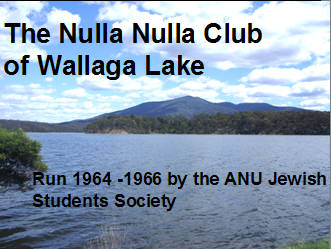 JEWS ACTIVE FOR ABORIGINALS
In the fight against Apartheid in South Africa
individual Jews played a leading role, although in 1970 there were only 119,000
Jews out of a total population of 22 million, but perhaps 2.5% of the governing
population.
In Australia where Jews are similarly sparse comprising just
0.4% of the nations population
-- Jews number amongst the
significant political and legal activists on behalf of Aboriginal rights.
However in Australia there is a further element of involvement starting
in 1964 when a mainline Jewish Organization -- the Australian National University Jewish Students Union -
became
directly involved with the isolated Aboriginal community of Wallaga Lake.
What was different about the social contract in Australia
that made possible Jewish organizational
activties in the 1960's that were inconceivable in South Africa prior to the 1980's?
Clues to the last question.
©Harvey A Cohen 2012 |

Diggers march Ben Yehuda St, Tel Aviv - WW2
Click on image to read the Ivrit shop signs
|
Download
History of Tel Aviv
A Powerpoint presentation
|
|
South Africa Versus Australia:
Jewish Response to Racial Oppression
All - or maybe only almost all - 'white' anti-apartheid activists in South Africa were Jews
Some died in the struggle -- others escaped from South Africa but were relentlessly pursued by letter bomb mail and other more 'diplomatic' means. But no mainstream Jewish organization in South Africa was active
in this struggle against apartheid during the 1960's.
But in Australia even before the famous referendum of 1967 at least one mainstream Jewish
organization, the ANU Jewish Students Society,
was active in furthering the full integration OUR First People into Australian society. Look for the
clues that explain more fully this great difference in organisational resonse in the 1960's.
|

The Factors for and the factors Against
Identity and identification
Accommodating diversity versus exclusivity
©Harvey A Cohen 2012
|
The Jewish people survived as a despised people living apart in Europe and as dhimmi in their ancestoral
Middle East homelands for centuries. With the enlightenment Jews
joined in mainstream European life -- and there was a great burst of Yiddish Culture.
In parallel during the Colonial era, European influence in Muslim lands both eased the disadvantages of the Jewish (and Christian ) dhimmis,
as well as providing the opportunities of growth and capitalism. But then ...
Almost 50 % were lost in the Holocaust, and post Colonialism rampant Arab nationalism
drove out the million Jews that once populated Middle East lands.
So the Jews now live In Israel, in Europe, in the Americas, Australia.
Can the Jewish communities outside Israel survive ? And what else ?
Can Jews survive in Europe when talk of a Jewish Problem
is not politically correct, but it is so so correct to promote the destruction of Israel itself.
And when immigrant minorities with rampant antisemitic attitudes
are gaining political clout.
Just what are the factors for and against continuity ?
What actions can community institutions take to truly foster continuity?
Are Jewish Schools necessary and sufficient,
or unnecessary and yet insufficient ? Should communal funds be firstly invested in Birthright Israel
sponsorship, or is that Soul Fusion supplies the answers.
In this section we link to both recent surveys of the Now,
and to the emergent Plans and strategies of the Now to foster continuity.
©Harvey A Cohen 2012
|
 Slaying the BDS Dragon
Left leaning media in Australia have given the BDS movement media support without limit
in Australia, leading to a series of most ugly boycott demonstrations against some retail businesses linked to Israel - notably
outlets of chocolate retailer Max Brenner outlets and cosmetics supplier Seacret.
These demonstrations with their ugly violence and harassment of innocent shoppers
have been a gross affront to Australian values of civility and fair go,
and despite the media spin have lead to counter-demonstrations by traditional Australians.
The first Brisbane counter demonstration was on
August 27, 2011, and is reported
here. A similar counter-demonstration is took place in Melbourne just days later.
What is striking is that these emerging groups comprise ordinary Australians, only a few if any Jews are involved.
In contrast to street demonstrations and counter-demonstrations,
throughout 2011 and 2012 Labour Federal frontbecher Michael Danby
sat down in avarious Max Brenner stores for chocolate with various prominent Australians.
By mid 2012 it is generally acknowledged that the BDS demonstrators -- with their notorious
anti-semitic chanting -- had become counterproductive in Australia.
©Harvey A Cohen 2012
|
Far beyond the Nazi and Soviet antisemitism of mid Twentieth Century,
a vicious antisemitism claiming to be anti-Zionism developed at the
end of that century. As the basic premise of anti-semitism is that Jews are lying
and manipulative,
this hatred of Jews is combined with the
claim that its just the nasty Jews who describe them as anti-semitic --
whereas these defamers claim to be true Human Rights Warriors.
Its shameful that the United Nations, which Australia's "Doc" Evatt played such a leading role in establishment
should be used as a prime vehicle for the dissemmination of such anti-semitism. But the
extremity and bizareness of this new anti-semtism produced a backlash,
with the formation of various citizen groups of Voices for Israel towards the end of the first decade of the Twenty First Century.
What was perhaps the most strikingly successful launch of an Israel support group, took place in Western Australia (WA).
Perth has a Jewish population of 9000; at the launch of AFOI(WA) there were
1500 present, of whom only around 300 (20%) were Jewish.
©Harvey A Cohen 2012
|
The World and Us
An ongoing series of audio presentations covering such areas as
- What is really going on in the Jewish World and the Middle East.
- How to bypass the spin of an often bigotted anti-Israel media.
- The actual history of the establishment of Israel .
- Sources -- written and online - of reliable information.
- Israeli society, technology, and humanitarian achievements.
- Just what is being broadcast in Arabic.
This is an amazing series, of one hour discussions in English, downloadable as podcasts.
Each episode is a unit of Contemporary Jewish History presented in a deft manner,
by Australian presenters who embody the complexity and plurality of the Australian Jewish Community. Presenter
Gabby, born in Budapest, where members of her family still live, with close relatives elsewhere in Europe,
has Australian post-graduate qualifications. Morry born in Australia, a
graduate of Tel Aviv University,
served in the IDF during the Yom Kippur War.
Contrast and balance is provided through interviews with a range of visiting experts,
with interludes of Yiddish and Israeli music.
The series,
The World and Us, was broadcast weekly on the first Melbourne Jewish Radio station,
Lion FM 96.1, 1910-11.
Outlines of broadcasts and some suplementary material available at the
podcast site.
©Harvey A Cohen 2012
|
Rokiskis and its obfuscated history
Dovid Katz's term, the "obfuscation of history" is well exemplified by looking at the case of
the small town of Rokiskis, in Lithuania, north of Vilnius/Vilna. This is a town with a Jewish
population for more than four hundred years, but bereft of Jews today.
The regional museum has displays that equate Stalin with Hitler,
equate communism with nazism,
and glorify as local heroes the right-wing "partisan" group,
initially called the LAF,
that collaborated with the Eizengruppen in the extermination of the Jewish 40%
of the local population. Later in the war this group fought with communist partisans, whose membership was open to Jews.
The Jewish contribution to the history
of Rokiskis is ignored except for one token reference.
©Harvey A Cohen 2012
|
Issues in Contemporary
Jewish
History
Journal of Fondazione CDEC
|
This online Journal, the very first issue of which was issued in 2010,
is certainly the first devoted to Contemporary, post-Holocaust Jewish history.
The publisher is the Italian organization Fondazione Centro di Documentazione Ebraica Contemporanea aka CDEC .
The next issue, edited by Cristian a Facchini is
devoted to
Modernity and the Cities of the Jews.
|
From the introduction to the very first issue, by the editors, Laura Brazzo and Guri Schwarz:
This monographic section (Focus) of the first issue of Quest is dedicated to the study of post-Holocaust European Jewry, a theme that only in very recent years has begun to be the object of systematic scholarly research. The turning point was of course the end of the cold war. In the early Nineties the palpable sense that new challenges were taking shape lead Jewish intellectuals to tackle, on the one hand, delicate issues regarding the future of the Jews and, on the other, opened new possibilities for historical research.
The entire content of the first issue of this brilliant new journal, is online at
http://www.quest-cdecjournal.it/. Papers there include
West German Jewry: Guilt, Power and Pluralism
by Anthony D. Kauders
Jews and Jewishness in Post-war Hungary
by Andr�s Kov�cs
The Jews in Poland after the Second World War
by Carla Tonini
State-sponsored Anti-Semitism in Postwar USSR
by Antonella Salomoni
©Harvey A Cohen 2012
|
 ©Harvey A Cohen 2012
|
This is an important resource on the state sponsored obfuscation of history
that is being developed in the Baltic States. Careful descriptions of the process are made by Dr Dovid Katz.
It is noteable that the site is also available as
www.HolocaustInTheBaltics.com.
Extensive Lithuanian sources are included, but because
of the use of machine translation, these sources
are difficult to read.
The intending reader is advised to first hear the podcast interviews
with Dovid Katz, episode
numbers 32 and 33 in the series available, with outlines on
The World and Us Website
©Harvey A Cohen 2012
|
©Harvey A Cohen 2012
|
Jewish Radio is a major new development in the Diaspora.
Actual full-time Jewish Radio stations
in the Diaspora have only come into existence in the past ten years.
What - apart from the emergence of more radio affordable technology -
has stirred this development of essentially full-time Jewish broadcasting stations?
What special challenges do these and future stations in the Diaspora face ?
How has Jewish Radio Now come about --
and will it survive ?




 Australia has a long history
of Jewish radio as there were unsuccessful plans for an AM radio in Sydney
during 1949-51, with actual Jewish programs on air in Sydney and Melbourne from the 1980's,
followed in 2010 by the birth of
Lion FM broadcasting in Melbourne 24-6,
and on the internet at LionFM.org.
This history is detailed
in www.TheHistoryOfNow.net/JewishRadioAustraliaNow.htm
with the story of Lion FM updated at
http://TheHistoryOfNow.Net/LionFMNow.htm
Australia has a long history
of Jewish radio as there were unsuccessful plans for an AM radio in Sydney
during 1949-51, with actual Jewish programs on air in Sydney and Melbourne from the 1980's,
followed in 2010 by the birth of
Lion FM broadcasting in Melbourne 24-6,
and on the internet at LionFM.org.
This history is detailed
in www.TheHistoryOfNow.net/JewishRadioAustraliaNow.htm
with the story of Lion FM updated at
http://TheHistoryOfNow.Net/LionFMNow.htm
©Harvey A Cohen 2012
|
Online Antisemitism 2.0
On Social networks and even Google Earth
©Harvey A Cohen 2012
|
Leading expert Dr Andre Oboler explains that
Around 2004, changes in technology created Web 2.0.[1] As technology
adapted, so did online antisemitism. With the new "social web"
came a new "social antisemitism." This Antisemitism 2.0 is the
use of online social networking and content collaboration to
share demonization, conspiracy theories, Holocaust denial, and
classical antisemitic motifs with a view to creating social
acceptability for such content.
This has lead to the birth of
Antisemitism 2.0
|

©Harvey A Cohen 2012
|
|
An documentary film is under development with an Australian producer/director
aiming to graphically detail how the Lithuanian state is actively
rewriting history. A promo for this documentary is on the website,
www.Rewriting-History.org.
Click on the logo to left for details and scope of this significant project.
|
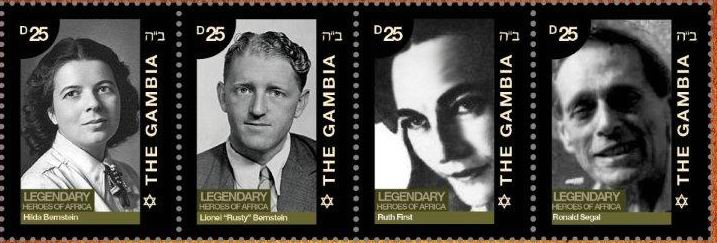
In March 2011 Liberia, Gambia and Sierra Leone
issued (simultaneously) a set of three commemorative postal sheets
devoted to 12 Jews � men and women � who fought Apartheid and racism in Africa.
An excellent
video documentary
overview of the history of the Jews in South Africa
is now online. The
crucial feature of the South African community is its predominate link with Lithunia,
where Jews had lived before Christianity arrived.
However with the expansion of Russia to incorporate Lithuania, the native
Jews, called Litvaks, came increasingly under repression, which culminated in a series of pograms
starting in the nineteenth century.
Litvaks with their own experience of repression have lead the
fight against Apartheid.
Rebecca Weiner's written overview of the history of the Jews in South Africa is
online.
©Harvey A Cohen 2012
|

In the period 1946 - 1951 the Anglo countries and South Africa displayed a
most ambiguous response to the emerging Jewish state,
with top leadership professing support, but vital government agencies in vigorous opposition.
More . . . .
|
©Harvey A Cohen 2012
|
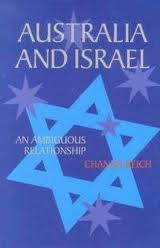 In his book (right) Chanan Reich introduced the term ambiguous relationship for the initial Australian
diplomatic relationship between Australia and Israel, but the term well covers broader aspects
of the relationship of the Anglo countries to Israel. Of special interest is
the extent to which material support, whether made-up clothing, animal feed,
or potential war materials were prevented from export from Australia to Israel.
Just six aircraft from Australia were acquired by Israel 1948-9,
but another 80 war surplus aircraft purchased by Australian Zionists could not be exported to Israel
even as scrap.
In his book (right) Chanan Reich introduced the term ambiguous relationship for the initial Australian
diplomatic relationship between Australia and Israel, but the term well covers broader aspects
of the relationship of the Anglo countries to Israel. Of special interest is
the extent to which material support, whether made-up clothing, animal feed,
or potential war materials were prevented from export from Australia to Israel.
Just six aircraft from Australia were acquired by Israel 1948-9,
but another 80 war surplus aircraft purchased by Australian Zionists could not be exported to Israel
even as scrap.
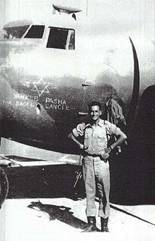
This Douglas DC-5, Called the Yankee Bagel - Pasher Lancet,
served in the Israel forces 1948-9.
The DC-5 had been registered in Australia
as VH-CXC before its export to Israel in May 1948,
immediately before a UN arms embargoe came into effect. Some other Australian planes
which were used to bring migrants to Australia were
acquired in Europe.
©Harvey A Cohen 2012
|
 When locally brewed Kosher Certified Craft lager became available in Australia in 2011 --
what did it tell about the community's viability and integration
into the broader Community ? If in doubt -- try drinking
Old Time Lager
When locally brewed Kosher Certified Craft lager became available in Australia in 2011 --
what did it tell about the community's viability and integration
into the broader Community ? If in doubt -- try drinking
Old Time Lager
©Harvey A Cohen 2012
|

|
Morry Sztainbok wrote on the Facebook page of Australians United for Israel:
I don't think I have ever posted this, but for a while, Melbourne had a thriving FM Jewish radio station, that I was blessed to be part of. Together with Gabby we tried to make sense of the world in discussions and interviews. The program is called "The World and Us", and whilst we are considering winding it down because the current AM frequency reaches very few people, our shows have been podcast and are available on the internet.
The most powerful and heartstopping interview, for me, was with Fr.
Patrick Desbois, a French priest who is still uncovering victims of the
Holocaust today
(Episode 36).
For those who may be interested in some of these current issues,
the discussions and interviews, with amazing individuals like Gal Lusky,
Michelle Rojas-Tal and Prof Dovid Katz, are available at
the podcast site
©Harvey A Cohen 2012
|
